Establishing a new life can be a complicated process - but we are here to help.
Our specialist Settlement Services team offers free information, referrals and support to help you, and your family settle into your new life here in WA.
A free walk-in service is available in the Perth metropolitan area, as well as case management services from our regional providers.
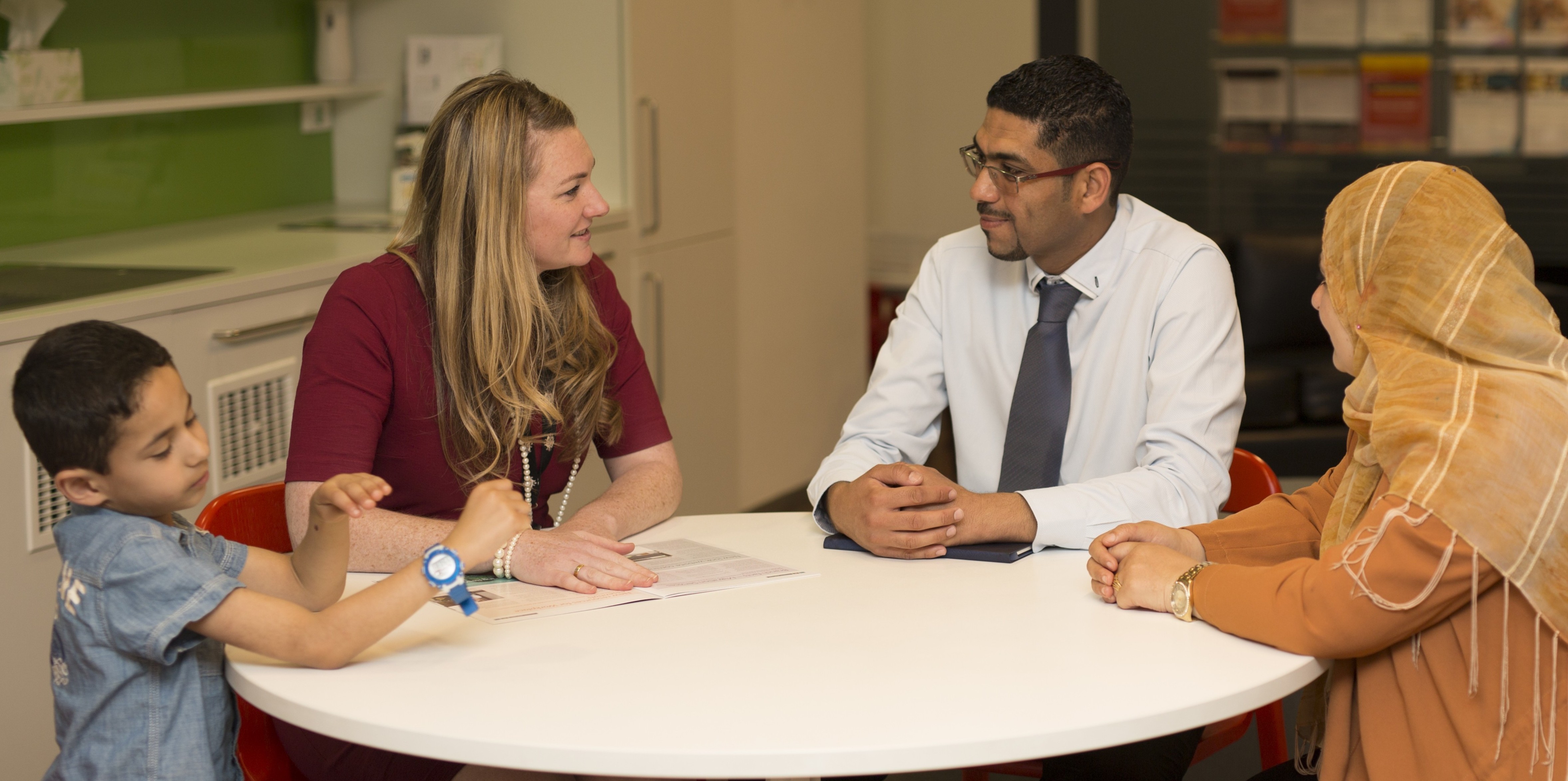
Pictured: Migration Services representative with skilled migrant family.
Build your own Settlement Services guide
We have compiled useful and important information to assist with your successful settlement journey.
You can browse one of the popular topics or categories, or search for something specific by following the instructions to use the Settlement Services filter.
You can also 'bookmark' information and build your own Settlement Services Guide to download and keep. Watch the "How to build your own Settlement Services Guide" for step-by-step instructions.
Support Services
Aged care support
Aged Care Volunteer Visitors Scheme
Umbrella Multicultural Community Care Services Inc. receives funding from the Australian Government to deliver the Aged Care Volunteer Visitors Scheme (ACVVS) to eligible participants across the Perth metropolitan area and Peel region.
The ACVVS is specially designed for seniors from multilingual, multicultural, multi-faith, and LGBTQIA+ backgrounds who are at risk of social isolation.
T: 08 9275 4411
LGBTIQA+ support
Forcibly Displaced People Network
The Forcibly Displaced People Network (FDPN) is a non-government and non-profit organisation supporting LGBTIQ+ people seeking asylum, refugees and migrants from diverse cultural backgrounds be safe in Australia. FDPN works to:
- connect you with the community;
- refer you to trusted services; and
- offer training and invite you to events.
W: fdpn.org.au
Living Proud
Formerly Gay and Lesbian Services of WA Inc, Living Proud is a non-profit organisation which aims to promote the wellbeing of LGBTIQA+SB and other sexuality, sex and gender diverse people in Western Australia.
To explore a list of local LGBTIQA+SB groups visit the Living Pride website.
QLife
QLife provides anonymous and free LGBTIQ+ peer support and referral for people in Australia wanting to talk about sexuality, gender, bodies, feelings or relationships.
Explore services and information for LGBTIQA+SB people of all ages in the QDirectory.
T: 1800 184 527 (3pm to midnight)
Migrant Support Services
Migrant community groups and networks
The Office of Multicultural Interests (OMI) coordinates programs to improve services for Western Australians from diverse cultural, linguistic and religious backgrounds.
A great way to find your way around a new environment is to join a community group from your country or with your ethnic background.
T: (08) 6552 7300 (OMI)
Libraries
Local governments partner with the State Library of WA, to deliver information services, exhibitions and events, as well as community groups and activities. Some public libraries also offer free specialist migrant support and English language support.
You can search for your local public libraries on the State Library of WA website.
T: (08) 9427 3111 (State Library of WA)
W: slwa.wa.gov.au/about/partnerships/local-government-public-libraries/find-public-library
Consulates in WA
Foreign governments are represented in Australia through consulates.
Migrants living in Western Australia are able to engage with their consulate whether it is located in WA or another state or territory. A list of all foreign embassies and consulates in Australia can be found on the Department of Foreign Affairs and Trade website.
T: (02) 6261 1111 (Department of Foreign Affairs and Trade)
Finding relatives
The Australian Red Cross Restoring Family Links program helps families who are separated by war, disaster and migration. This work includes finding missing loved ones, re-establishing contact, exchanging family news and clarifying the fate of the missing.
T: 1800 875 199 (Australian Red Cross)
W: redcross.org.au/migration/find-my-family-restoring-family-links
Multicultural Futures
Delivering a range of services to help migrants and refugees to build meaningful lives in WA, Multicultural Futures are located at 241–243 High Street, Fremantle WA 6160.
T: (08) 9336 8282 (Multicultural Futures)
Playgroups and kids clubs
A playgroup is made up of a group of parents and their young children who meet together for interaction and play. Children normally attend from birth to kindergarten or school age.
Playgroups are run by members and meet in a variety of venues, with more than 500 playgroups across Perth and Rregional WA.
T: 1800 171 882 (Playgroup WA)
Advocacy
Advocacy services work to improve the outcome for individuals to ensure people living in Australia are able to live with dignity. They seek to promote fair treatment, enforcement of rights and access to justice for migrant workers.
Migrant Justice Institute
The Migrant Justice Institute undertakes strategic research and public engagement to achieve fair treatment, enforcement of rights and access to justice for migrant workers.
English Language Support
Adult Migrant English Program
To support eligible migrants and humanitarian entrants, the Commonwealth government offers the Adult Migrant English Program (AMEP) to assist with functional English skills. Unlimited free English Language classes are now available to eligible migrants through AMEP.
Eligibility requirements can be found on the Department of Home affairs website, as well as a list of the AMEP providers in metropolitan and regional WA.
W: immi.homeaffairs.gov.au/settling-in-australia/amep/about-the-program
Online courses
AMEPOnline provides free English learning resources for all eligible migrants. This service can be accessed online or through the free AMEPOnline app. Eligible migrants can use these courses to participate socially and economically in Australia.
Online courses: ameponline.homeaffairs.gov.au
Culturally and Linguistically Diverse specialist services
This specialist service offers free career and training advice to people from culturally and linguistically diverse (CaLD) backgrounds. Services are available face to face, online or over the phone.
T: (08) 9328 2699 (CaLD specialist services)
Skills for Education and Employment program
The Skills for Education and Employment (SEE) program gives eligible people up to 800 hours of free training to help improve their reading, writing and mathematics skills.
T: 1800 805 260 (SEE program)
Translating and Interpretation
Interpretation services
The Translating and Interpreting Service (TIS) is a national interpreting service for people who do not speak English and want to access services and information in Australia. Generally, this service is free to non-English speakers, as the organisation you wish to contact will accept the charges. You can pre‑book a phone interpreter or book a face to face appointment.
T: 1800 131 450 (TIS)
Translating of documents
Free document translation
If any of your personal documents are not written in English, you will need to have summaries/extracts of them translated into English. Eligible people settling permanently in Australia can have up to ten eligible documents translated into English, within the first two years of their eligible visa grant date.
T: 131 450 (TIS National)
T: (02) 8776 3383 (The Migration Translators)
W: translating.homeaffairs.gov.au/en
Paid document translation
If you are not eligible for the free service above or you have other documents that need to be translated, the NAATI online directory lists certified and recognised translators or interpreters.
T: 1300 557 470 (NAATI)
W: naati.com.au
Refugee Support
Refugee support
Refugees and asylum seekers living in Western Australia are able to access support services through the Refugee Council of Australia (RCOA). RCOA are a nonprofit organisation, independent of government that work with Refugees and the services that support them.
T: (02) 9211 9333 (RCOA)
Discover Western Australia
Discover the Peel region
Peel - Regional snapshot
The Peel region is the fastest growing of all the regions in WA with well-serviced infrastructure and attractive lifestyle options contributing to its popularity. With a growing number of residential developments, it is a popular choice for skilled migrants wanting the variety of a coastal and rural lifestyle – and all within easy reach of the Perth metropolitan area! With over 43 government and private schools and numerous well-equipped sporting facilities and venues, it is an ideal location that’s big on lifestyle yet less than an hour (75 km) from Perth by car or train.
The city of Mandurah is the regional business hub and home to around 65 per cent of the region’s population. Offering cosmopolitan city living with historic riches and a coastal lifestyle, and known for its spectacular waterways and the Peel–Harvey estuary’s abundant wildlife, pristine beaches and natural beauty, it’s the ideal place to create your future!
The retail sector is a large employer and an important contributor to the Peel economy. Other major employers are construction and manufacturing along with a large number of employees working in healthcare and social assistance, and food and accommodation services. Its largest industry is alumina production, along with mining and mineral processing.
For more information about Peel, visit:
W: Peel Development Commission
W: Regional Development Australia – Peel
W: Move to More
Peel - Career guidance
For career guidance and information on training courses, visit the Jobs and Skills WA website or call a Jobs and Skills Centre.
T: 13 64 64 (Jobs and Skills WA)
Peel - Education and training options
The Peel Education and Training campus located in Mandurah hosts courses delivered by:
Discover Perth
City living
Perth’s central business district (CBD) is situated along the beautiful Swan River and includes offices, financial institutions, and several dining and retail attractions. Adjacent to the CBD sits Perth’s vibrant Northbridge entertainment district offering cafés, restaurants, bars, nightlife, cultural events and festivals. For those wanting an urban lifestyle, key inner-city suburbs where apartment living is prominent include:
- Perth (city);
- East Perth;
- West Perth;
- South Perth; and
- Northbridge.
Neighbouring suburbs that are close to the Perth city area, with both apartments and character homes plus popular café strips, recreation facilities and parks include:
- Leederville;
- Subiaco;
- Mount Hawthorn; and
- Mount Lawley.
Climate
Australia has a diverse range of climate zones, varying from tropical in the north to temperate in the south. Being Australia’s largest state, WA enjoys both of these climate zones.
Perth has more days of sunshine than any other major Australian city, with the south west corner of WA enjoying a Mediterranean climate and the north of the state typically being warmer.
You can visit the Bureau of Meteorology website for seasonal weather statistics and forecasts across Australia.
History and culture
Boorloo (Perth) is located on the ancestral lands of the Whadjuk Noongar peoples, one of 14 Noongar clans that make up the largest Aboriginal cultural block in Australia. The Noongar people have been the Traditional Custodians of the South West of WA for over 45,000 years, maintaining deep cultural, spiritual and environmental connections to Country.
In 1829, the British Government established a settlement in the area, which they referred to as the Swan River Colony. This area is now known as Perth – Boorloo.
WA spans a vast and diverse geographical area and is home to many distinct Aboriginal language groups and nations, each with their own unique cultures, histories, and connections to Country. To find out more about the Traditional Custodians of the land you are on, you can explore the AIATSIS Map of Indigenous Australia.
To learn more about Aboriginal culture in WA, you can visit the WA Indigenous Tourism Operators Council (WAITOC) website or search online for “Western Australian Aboriginal culture”.
The Western Australia tourism website also offers a range of Aboriginal experiences that invite you on a journey through the Dreaming and explore the rich cultural heritage across the State.
Say hello in Noongar: Kaya (pronounced kai-ya)
Metropolitan Education and training
Education is at the heart of WA, with more than 125 high-quality education providers including schools, colleges, pathway providers, English language institutions and five universities that are ranked in the top 40 worldwide for many subjects. With such a selection of quality education providers, and a bustling local and international student cohort, you’ll find lots of support and flexible study pathways.
Perth - our capital city
Nestled within the vast landscape of WA where the winding Swan River joins the southwest coast, Perth is Australia’s sunniest capital city blending vibrant urban cool with laid back natural beauty. Bustling with restaurants, bars, cultural spaces and shopping, Perth is also home to Kings Park, one of the world’s largest and most beautiful inner city parks.
You can explore the idyllic vineyards and serene landscapes of the Swan Valley, just a 30 minute drive from the Perth city centre. Or follow the coast to discover 19 scenic beaches strung along the 50 km metropolitan shoreline – WA’s lifestyle is like no other.
Perth is regularly recognised as one of the world’s best destinations by Lonely Planet, National Geographic, the New York Times and Forbes.
For more information about Perth, visit:
W: Visit Perth
Perth Hills
For a less suburban lifestyle, ‘the hills’ on the eastern fringe of Perth offer spectacular scenery, native bushland and generally larger properties. Driving through Darling Scarp townships such as Armadale, Mundaring and Kalamunda you'll find breath taking views, heritage-listed hotels and country charm a plenty.
With nature trails, art galleries, farmers markets, fruit picking and wine tasting, the hills offer a perfect lifestyle destination just 45 minutes for the Perth CBD.
Suburban living
Northern suburbs
Also referred to by locals as ‘north of the river’, the northern suburbs line the coast and expand inwards. House prices generally increase the closer you are to the coast. The northern suburbs are generally well established; however, newly established suburbs continue to pop up and are regularly releasing new estates with vacant land.
Southern suburbs
Also known as ‘south of the river’, the southern suburbs are generally well established and include newer estates with vacant land. Fremantle (20 km from Perth CBD) offers a mix of contemporary housing, heritage cottages and apartment living. Fremantle is home to WA’s busiest working port and is also known for its music, arts and culture, festivals, retail stores, markets, cafés and restaurants.
Eastern suburbs
Perth's eastern suburbs represent an attractive destination for visitors and provide a high quality of life for residents. This area is home to an extensive range of heritage, culture and arts attractions including Guildford, which is one of the oldest settled areas in WA, and the popular Swan Valley with semi-rural property, residential housing and regular land releases available.
Discover the Gascoyne region
Gascoyne - Career guidance
For career guidance and information on training courses, visit the Jobs and Skills WA website or call a Jobs and Skills Centre.
T: 13 64 64 (Jobs and Skills WA)
Gascoyne - Education and training options
Carnarvon, Exmouth and Shark Bay offer primary school education while secondary school facilities are located in Exmouth and Carnarvon. There are also some private schools in Carnarvon.
Central Regional TAFE offers a wide range of courses throughout the Gascoyne region. Campuses are located in Carnarvon and Exmouth.
Gascoyne - Regional snapshot
The Gascoyne is a great place for you and your family to settle. With an average of 320 days of sunshine a year, this is a popular destination for those seeking a warm climate all year round! Located in the northwest of WA with more than 600 km of Indian Ocean coastline, the Gascoyne extends inland to desert landscapes and the Aboriginal community of Burringurrah.
With lots of natural environment to draw you outdoors, this region lends itself superbly to boating, fishing, camping, surfing and sport; and its economy is based on tourism, fishing, retail, mining, horticulture and pastoralism, and small business. One of the main tourist attractions in the Gascoyne is Ningaloo Reef, a coral reef stretching over 260 km. It’s considered one of Earth’s last ocean paradises. The surrounding area includes the Kennedy Range and Mount Augustus.
If you choose to live in one of its three major coastal towns – Carnarvon, Exmouth or Shark Bay – you’ll never be far from a beach. With median house prices significantly lower than Perth, its clean environment and supportive local community make it a welcoming region in which to settle.
For more information about the Gascoyne, visit:
W: Gascoyne Development Commission
W: Regional Development Australia – Mid West Gascoyne
W: Move to More
Discover the Goldfields-Esperance region
Goldfields-Esperance - Career guidance
For career guidance and information on training courses, visit the Jobs and Skills WA website or call a Jobs and Skills Centre.
T: 13 64 64 (Jobs and Skills WA)
Goldfields-Esperance - Designated Area Migration Agreement
The City of Kalgoorlie–Boulder has established a Designated Area Migration Agreement (DAMA) with the Department of Home Affairs. This agreement has its own occupation list providing employers in the region with access to a broader range of skilled workers, utilising the labour agreement stream of the:
- Skills in Demand (formerly TSS) visa (subclass 482); the
- Skilled Employer Sponsored Regional (Provisional) visa (subclass 494); and the
- Employer Nomination Scheme (subclass 186).
Please note: The WA Government is not formally involved in the City of Kalgoorlie–Boulder DAMA. Employers in this region should contact the City of Kalgoorlie–Boulder for further information.
T: +61 08 9021 9600 (The City of Kalgoorlie–Boulder)
Goldfields-Esperance - Education and training options
The Western Australian School of Mines located in Kalgoorlie offers various science courses.
Central Regional TAFE in Kalgoorlie and South Regional TAFE in Esperance offer a range of courses at their campuses.
Goldfields-Esperance - Regional Certifying Body
Skilled Employer Sponsored Regional (Provisional) visa (subclass 494)
The Skilled Employer Sponsored Regional (Provisional) visa (subclass 494) (SESR) is a Department of Home Affairs visa that allows Australian employers in regional Australia to sponsor (nominate) skilled migrants to fill employment vacancies, where the employer cannot source an appropriately skilled Australian worker.
Employers in regional Australia can nominate skilled migrants to fill a full-time vacancy, ongoing for at least two years, where there is a demonstrated and genuine need for a paid employee. Regional Development Australia is the Regional Certifying Body (RCB) for the Goldfields–Esperance region. Contact them directly to find out more about the assessment process.
T: +61 08 9091 6051 (from outside Australia Regional Development Australia)
W: rdage.org.au
Goldfields-Esperance - Regional snapshot
Situated in the south eastern corner of WA, this is the largest region in the State. Well known for its great sense of community spirit and its friendly inhabitants, this region has a long, rich association with gold and nickel mining along with agriculture producing wheat and barley.
This is the place for you if you want to be close to nature, love the outdoors and immerse yourself in unspoilt landscapes and seascapes. You can also experience a vibrant arts scene, great shopping, bars, restaurants and cafes and enjoy sporting activities. Come and experience this great lifestyle for yourself!
The region offers a range of employment and business opportunities including tourism, agriculture, health and mining as well as many trades. Retail is the second largest employer followed by manufacturing. Commercial fishing operates mainly along the coastlines of the shires of Ravensthorpe and Esperance. It has a reputation for innovation, uniqueness and diversity, with Curtin University delivering vibrant higher education in the dynamic and sophisticated regional centre, Kalgoorlie–Boulder. A quick internet search will show you the median house prices in the area.
For more information about Goldfields-Esperance, visit:
W: Goldfields–Esperance Development Commission
W: Regional Development Australia Goldfields–Esperance
W: Move to More
Discover the Great Southern region
Great Southern - Career guidance
For career guidance and information on training courses, visit the Jobs and Skills WA website or call a Jobs and Skills Centre.
T: 13 64 64 (Jobs and Skills WA)
Great Southern - Education and training options
South Regional TAFE is the region's largest provider of nationally accredited training, industry and lifestyle courses. Campuses are located in:
The University of Western Australia's Albany Centre offers a number of undergraduate courses.
Great Southern - Regional snapshot
You’ll find the people in this region friendly and welcoming — it’s no wonder that it’s the destination of choice for many skilled migrants in the professional, trades and services sectors. The stunning scenery is a great attraction in itself, especially for those who appreciate nature. With a rich variety of flora and fauna in the rugged Porongurup and Stirling Ranges, the natural sweeping views and the serene beauty of the seascape and landscape are impressive.
The historic port city of Albany offers rugged coastlines, tall timber forests and clean, safe environment while other towns such as Denmark, Esperance and Mount Barker are equally idyllic. With plenty of outdoor activities to enjoy, a thriving arts and entertainment scene and affordable housing, the Great Southern region offers you the chance to live the dream!
The Great Southern region is WA’s second largest agricultural producer with the focus on grains and livestock. Its economy is driven by primary production – wool, timber, livestock and fishing — with key growth areas in the transport, engineering and commercial services areas. Viticulture and tourism also play a large role, attracting a growing number of tourists every year.
For more information about the Great Southern, visit:
W: Great Southern Development Commission
W: Regional Development Australia – Great Southern
W: Move to More
Discover the Kimberley region
Kimberley - Career guidance
For career guidance and information on training courses, visit the Jobs and Skills WA website or call a Jobs and Skills Centre.
T: 13 64 64 (Jobs and Skills WA)
Kimberley - Designated Area Migration Agreement
The East Kimberley Chamber of Commerce and Industry has established a Designated Area Migration Agreement (DAMA) with the Department of Home Affairs. This agreement has its own occupation list providing employers in the Shire of Wyndham with access to a broader range of skilled workers, utilising the labour agreement stream of the:
- Skills in Demand (formerly TSS) visa (subclass 482);
- Skilled Employer Sponsored Regional (Provisional) visa (subclass 494); and the
- Employer Nomination Scheme (subclass 186).
Please note: The WA Government is not formally involved in the Kimberley DAMA. Employers in this region should contact the East Kimberley Chamber of Commerce and Industry for further information.
T: 0429 484 662 (East Kimberley Chamber of Commerce and Industry)
W: ekcci.com.au
Kimberley - Education and training options
North Regional TAFE offers over 160 qualifications and short courses throughout the region. Campuses are located in:
Notre Dame University's Broome campus offers vocational education and training, tertiary pathway programs, higher degree and research opportunities.
Kimberley - Regional snapshot
An ancient landscape covering hundreds of thousands of square kilometres, with unique and dramatic landscapes and stunning outback settings that are like no other, the Kimberley region in WA’s north comprises outback desert, impressive deep, rocky gorges, limestone caves, sandstone cliffs, grassy plateaus, thundering waterfalls, and an abundance of wildlife. It is also home to the magnificent Lake Argyle, the largest freshwater lake in mainland Australia.
Three times larger than England but with a population of less than 40,000 people; the Kimberley offers stunning beaches, native wildlife, natural gorges and canyons, freshwater swimming holes with no shortage of land to explore and unique cultural experiences.
Mining, construction, tourism and hospitality, retail, agriculture, and pearling are major contributors to the region's economy and offer fantastic employment opportunities.
For more information about the Kimberley, visit:
W: Kimberley Development Commission
W: Regional Development Australia – Kimberley
W: Move to More
Discover the Mid West region
Mid West - Career guidance
For career guidance and information on training courses, visit the Jobs and Skills WA website or call a Jobs and Skills Centre.
T: 13 64 64 (Jobs and Skills WA)
Mid West - Education and training options
Central Regional TAFE is one of the main training providers in the Mid West region. Campuses are located in:
- Geraldton (main campus); and
- Batavia Coast.
Mid West - Regional snapshot
The Mid West region of WA is widely recognised for its unique natural environment, comprising a coastline dominated by limestone cliffs, and is the perfect playground if you like to indulge in water sports. The city of Geraldton on the magnificent Batavia coast is home to around 70 per cent of this region’s population, but if you head east for 800 km, you’ll enter a mineral rich hinterland that borders the Pilbara and Goldfields–Esperance regions.
Add a Mediterranean climate with hot, dry summers and cold, dry winters and you’ll find a great location for starting off your new life in WA. Strong, supportive social infrastructure and relatively cheap housing add to this region’s attractions.
The Mid West has a diverse economy built around tourism, fishing, agriculture and mining. There is also a fairly significant manufacturing sector catering to the needs of the mining, fishing and agricultural industries both within and outside the region.
For more information about the Mid West, visit:
W: Mid West Development Commission
W: Regional Development Australia – Mid West Gascoyne
W: Move to More
Discover the Pilbara region
Pilbara - Regional snapshot
The centre of Australia’s mining and oil and gas industries and rich in natural resources – predominantly iron ore – the Pilbara region is the mining powerhouse of WA and critical to Australia’s economy. It is full of contrasts and surprises with spectacular gorges, ravines, waterfalls and vast red deserts. With the Indian Ocean to the northwest and the Great Sandy Desert in the east, the diverse landscape within the Pilbara region offers a variety of lifestyles.
The major Pilbara towns of Karratha and Port Hedland have grown significantly in the past 10 years, with considerable investment in new shopping centres, hospitals, schools, and sports and recreational facilities – transforming the towns into modern hubs for the region. Two major airports connect the region to Perth and other Australian cities.
For more information about Pilbara, visit:
W: Pilbara Development Commission
W: Regional Development Australia – Pilbara
W: Move to More
Pilbara - Designated Area Migration Agreement
Regional Development Australia Pilbara (RDA Pilbara) has established a Designated Area Migration Agreement (DAMA) with the Department of Home Affairs. This agreement has its own occupation list providing employers in the Shire of East Pilbara, City of Karratha, and the Town of Port Hedland with access to a broader range of skilled workers, utilising the labour agreement stream of the:
- Skills in Demand (formerly TSS) visa (subclass 482);
- Skilled Employer Sponsored Regional (Provisional) visa (subclass 494); and the
- Employer Nomination Scheme (subclass 186).
Please note: the WA Government is not formally involved in the Pilbara DAMA. Employers in this region should contact RDA Pilbara for further information.
T: 0499 325 584 (RDA Pilbara)
Pilbara - Career Guidance
For career guidance and information on training courses, visit the Jobs and Skills WA website or call a Jobs and Skills Centre.
T: 13 64 64 (Jobs and Skills WA)
Pilbara - Education and training options
North Regional TAFE is one of the main training providers in the region offering a range of courses at campuses located in:
Discover the South West region
South West - Career guidance
For career guidance and information on training courses, visit the Jobs and Skills WA website or call a Jobs and Skills Centre.
T: 13 64 64 (Jobs and Skills WA)
South West - Designated Area Migration Agreement
The South West region has established a Designated Area Migration Agreement (DAMA) with the Department of Home Affairs. This agreement has its own occupation list providing employers in the South West region with access to a broader range of skilled workers, utilising the labour agreement stream of the:
- Skills in Demand (formerly TSS) visa (subclass 482);
- Skilled Employer Sponsored Regional (Provisional) visa (subclass 494);and the
- Employer Nomination Scheme (subclass 186).
Please note: the WA Government is not formally involved in the South West DAMA. Employers in this region should contact the Shire of Dardanup for further information.
T: 08 9724 0000 (Shire of Dardanup)
South West - Education and training options
South Regional TAFE has numerous courses available with campuses located in:
- Bunbury;
- Busselton;
- Collie;
- Harvey;
- Manjimup; and
- Margaret River (part of the Margaret River Education campus).
Edith Cowan University's South West Campus located in Bunbury is the university's largest campus outside of the metropolitan area.
Margaret River Education campus hosts range of courses delivered by:
South West - Regional snapshot
With a great sense of community and connectedness and an inviting lifestyle, residents of South West WA rate their region as a safe, family-friendly place to live. It features some of the State’s best beaches, forests, wine regions and national parks, and the climate in this dynamic, evolving region in the picturesque south western corner of WA is ideal for migrants due to its spectacular nature and diverse employment opportunities.
Lifestyle and thriving employment opportunities available in the region make the South West a popular choice to live and invest in. The main industry sectors and employers include mining and minerals (coal, alumina, mineral sands), manufacturing (timber products; food and beverage enterprises), building and construction (residential housing developments), tourism (wine regions; surfing; forests), food and agribusiness (primary produce; food and vegetables), wine and viticulture, forestry, fishing and aquaculture, retail and commerce, health, and smart and creative industries such as boutique artisans; film-makers; and visual arts. The city of Bunbury is the commercial and administrative hub of this region.
For more information about the South West, visit:
W: South West Development Commission
W: Regional Development Australia – South West
W: Move to More
Discover the Wheatbelt region
Wheatbelt - Career guidance
For career guidance and information on training courses, visit the Jobs and Skills WA website or call a Jobs and Skills Centre.
T: 13 64 64 (Jobs and Skills WA)
Wheatbelt - Education and training options
Central Regional TAFE and South Regional TAFE deliver a range of training and education services in the Wheatbelt region. Campuses are located in:
Muresk Institute (located in Northam) hosts the delivery of various agriculture and agribusiness courses.
Wheatbelt - Regional snapshot
The Wheatbelt region belongs to a vast and surprisingly diverse region of outback Australia known as WA’s Golden Outback. Also known as the Heartlands, the Wheatbelt offers an escape from city life in a safe and relaxed environment with more than 200 towns and communities offering a range of liveability options.
Some of the attractions in the region include the Narembeen Grain Discovery Centre, Wave Rock near Hyden, and the Wagin Historical Village.
The Shire of Northam is the largest regional centre, with population distributed throughout the region which boasts 150 km of a pristine coastline lucrative to the fishing industry — particularly rock lobsters for domestic consumption and export.
The Wheatbelt is well known for its magnificent wildflowers as well as for its rich agricultural history in cropping – producing almost half of WA's agricultural crops. It is the main producer of cereal crops and other products such as canola, vegetables, honey, citrus fruits, olives, wine grapes and livestock. Its vibrant economy is supported by construction, the retail trade and fisheries. It also offers affordable housing and extensive education, health, cultural and recreational services.
For more information about the South West, visit:
W: Wheatbelt Development Commission
W: Regional Development Australia – Wheatbelt
W: Move to More
Employment
Australian Workplaces
Businesses in WA
Businesses in Western Australia operate under two different industrial relations systems that cover employee rates — the State system, and the national fair work system. Which of these two systems covers a particular employee depends on the type of business structure of the employer. Each of these two systems has different employment rights and obligations, so it is important you know which system your workplace sits under.
If you are not sure which system covers your work, you can contact Wageline and provide the name of the business or the ABN, and Wageline can assist with a business search over the phone.
T: 1300 655 266 (Wageline)
W: wa.gov.au/organisation/private-sector-labour-relations/stay-informed-wageline
WA State System
The state system covers businesses and organisations (and their employees) that operate as:
- sole traders (eg Jane Smith trading as Jane’s Café);
- unincorporated partnerships (eg Jane and Bob Smith trading as Jane’s Café);
- unincorporated trust arrangements (eg Jane and Bob Smith as trustees for the Smith Family Trust trading as Jane’s Café); or
- incorporated associations and other not for profit organisations that are not trading or financial corporations.
T: 1300 655 266 (Wageline)
W: wa.gov.au/organisation/private-sector-labour-relations/stay-informed-wageline
National System
The national system covers businesses and organisations (and their employees) that operate as:
- Pty Ltd businesses that are trading or financial corporations (eg Smith Pty Ltd trading as Jane’s Café);
- incorporated partnerships (eg Smith Pty Ltd and Bob Smith trading as Jane’s Café);
- incorporated trust arrangements (eg Smith Pty Ltd as trustee for the Smith Family Trust trading as Jane’s Café); or
- incorporated associations and other not for profit organisations.
T: 13 13 94 (Fair work)
Employee rights and conditions
Income tax
The Australian Taxation Office (ATO) collects taxes from the income of all working Australians for the Australian Government — the amount you pay will depend on your total wage or salary. When your employer pays your salary or wage, they take out tax and send it to the ATO. Your payslip will show how much tax has been taken out.
T: 13 13 94 (ATO)
W: ato.gov.au/individuals-and-families/jobs-and-employment-types/new-to-tax-and-super
FairWork Ombudsman
The Australian Government's FairWork Ombudsman has videos available in a range of languages to assist you in understanding your rights and obligations in Australian workplaces.
The videos have information about basic workplace rights and entitlements to help you check you're getting the right pay and make sure you are following Australian workplace laws.
T: 13 13 94 (Fair Work)
SafeWork Australia
Work, health and safety laws protect all workers in Australia, even if you are on a temporary visa. You have a right to a safe and fair workplace.
SafeWork Australia has information available in different languages for people who are new to working in Australia, so that you can be aware of your rights to work in a safe and healthy environment.
T: (02) 6240 0303
Work Right Hub (Australian Red Cross)
The Australian Red Cross has developed a Work Right Hub on their website, with information to help you find support if you (or someone you know) feels that you may be being exploited at work in Australia.
It includes information about underpayment or not being paid; discrimination, bullying or harassment, and work safety.
T: 1800 733 276
National Employment Standards
The National Employment Standards (NES) are 11 minimum employment entitlements that have to be provided to all employees in Australia. They include the national minimum wage rate and other conditions such as leave.
All employees in the national workplace relations system are covered by the NES. This is regardless of the Award, Agreement or employment contract that applies.
T: 13 13 94 (Fair Work)
W: fairwork.gov.au/employment-conditions/national-employment-standards
Awards
Awards (modern awards) are legal documents that outline the minimum pay rates and conditions of employment specifically for an industry or occupation, and detail the rights of all employees, and workers on visas.
There are more than 100 industry or occupation awards that cover most people who work in Australia.
T: 13 13 94 (Fair Work)
Agreements
Some businesses may have an Agreement between an employer and their employees regarding employment conditions. An agreement must be approved by and registered with the Fair Work Commission and by law cannot offer less than the legal minimum entitlements set out in the National Employment Standards (NES), an Award, or other registered agreements that may apply.
T: 13 13 94 (Fair Work)
Employer contracts
An employment contract is an agreement between an employer and employee that sets out terms and conditions of employment. A contract can be in writing or verbal (however; it is always recommended that any employment contract should be written).
By law, an employment contract cannot offer less than the legal minimum entitlements set out in the National Employment Standards (NES), an Award, an Agreement, or other registered agreements that may apply.
T: 13 13 94 (Fair Work)
Pay rates
When you are covered by an Award, your employer is required by law to pay you the rates outlined in that Award, including any penalty rates (higher pay rates) for working weekends or overtime. An Award applies automatically if you or your employer are in the right industry or occupation.
If your industry or occupation is not covered by an Award, you will be entitled to the national minimum rate of pay and your employer is required by law to pay you this rate. Minimum rates of pay apply to full time, part time and casual employees including junior employees, and workers on visas.
T: 13 13 94 (Fair Work)
Minimum wage
All employees working in Australia are entitled to be paid a minimum wage. This is the minimum amount an employee can be paid for the work that they're doing.
The minimum wage refers to the amount of pay before tax is taken out (your gross pay). The actual rate is provided by the Fair Work Act and reviewed each year.
T: 13 13 94 (Fair Work)
Overtime and Allowances
Employees may be entitled to overtime or a higher pay rate for working at particular times of the day, on certain days of the week, or if they are required to work on a public holiday. They may also be entitled to an allowance or other entitlements — for example; if they need to wear special clothing at work, are working in a remote location, using their own vehicle for work, or travelling for work.
The specific rate or allowances will depend on the Award, Agreement or other industrial instrument that applies.
T: 13 13 94 (Fair Work)
W: fairwork.gov.au/pay-and-wages/allowances-penalty-rates-and-other-penalties
Tax returns
In Australia, the financial year runs from 1 July to 30 June. Generally, when you have tax taken out of your pay or salary or earn over $18,200 during the financial year, you need to lodge a tax return detailing your income and any deductions to the Australian Tax Office (ATO).
The ATO calculates how much tax should be paid on your income, less the amount your employer has already sent, and considers any taxable deductions you may have. If you have paid more income tax than required, you may receive a refund from the ATO
T: 13 13 94 (ATO)
W: ato.gov.au/individuals-and-families/jobs-and-employment-types/new-to-tax-and-super
Superannuation
Superannuation is like a savings fund that builds through your working life, and in general can be accessed once you reach retirement age.
Minimum contributions of 11.5 per cent of an employee's ordinary time earnings must be paid by the employer to the employee’s nominated superannuation fund when an employee is over 18 years of age, or under 18 years and working over 30 hours a week.
Your payslip will show how much superannuation your employer is paying. Employees may also make direct contributions to their superannuation fund, if they wish.
T: 13 10 20 (Fair Work)
W: fairwork.gov.au/pay-and-wages/tax-and-superannuation#super-guarantee
Work hours and leave
Awards, agreements and other contracts will have rules about how an employee's hours of work should be set. This includes the hours of work you are required to complete; breaks you're entitled to; when overtime applies; and your work roster.
Full time and part time employees usually work a set number of hours a week and get paid public holidays, annual leave, and personal leave such as for illness or caring for a family member. Casual employees usually work a roster that changes each week and receive a higher pay rate (casual loading) but do not get paid leave. All employees have an entitlement to paid long service leave.
T: 13 13 94 (Fair Work)
Health and Safety
All workers in WA are covered by the Work Health and Safety Act 2020, which provides a framework to protect the health, safety and welfare of workers in WA workplaces, and of other people who might be affected by the work.
Workers' compensation is a form of insurance payment to employees if they are injured at work or become sick due to their work. It includes payments to employees to cover their wages while they're not fit for work, medical expenses and rehabilitation.
T: 1300 307 877 (WorkSafe)
Discrimination
In Australia, everyone has the right to not be bullied, sexually harassed or discriminated against at work. This includes any kind of harassment or discrimination based on your sex, race or culture, religion, or gender identity.
Under Australian law, your employer has a responsibility to safeguard you against bullying, sexual harassment and discrimination in your workplace and ensure that all employees are treated equally and given equal opportunities.
T: 13 13 94 (Fair Work)
W: fairwork.gov.au/employment-conditions/bullying-sexual-harassment-and-discrimination-at-work
Employee protections
The Fair Work Act gives all employees protected rights, called ‘general protections’, at work. These protected rights include workplace rights; your safety at work; taking or not taking part in industrial activities or belonging or not belonging to an industrial association such as a trade union; and being free from discrimination of any kind.
Under these acts, you have the right to lodge a complaint or seek support if you feel your rights are being violated in the workplace or if you believe your employee rights such as pay conditions are not being met. This is particularly important if you are experiencing any kind of discrimination or harassment in the workplace.
T: 13 13 94 (Fair Work)
W: fairwork.gov.au/employment-conditions/protections-at-work
Migrant Worker Protection Laws
Important new laws protecting migrant workers against exploitation aim to deter employers and others in the labour chain from using a person’s migration status to exploit them.
The laws protect all migrant workers, regardless of their visa status.
There are now stronger reporting protections for visa holders experiencing workplace exploitation. You can anonymously report workplace exploitation to either the Fair Work Ombudsman or Border Watch.
You can also access in-language material on the Migrant Worker Protections webpage, which includes a translated comic strip and animation. To learn more about workplace rights for visa holders and migrants, visit the Fair Work Ombudsman website.
T: 13 13 94 (Fair Work)
Finding Employment
Businesses in WA
Businesses in Western Australia operate under two different industrial relations systems that cover employee rates — the State system, and the national fair work system. Which of these two systems covers a particular employee depends on the type of business structure of the employer. Each of these two systems has different employment rights and obligations, so it is important you know which system your workplace sits under.
If you are not sure which system covers your work, you can contact Wageline and provide the name of the business or the ABN, and Wageline can assist with a business search over the phone.
T: 1300 655 266 (Wageline)
W: wa.gov.au/organisation/private-sector-labour-relations/stay-informed-wageline
Finding employment
There are ample opportunities for migrants to live and work in Western Australia.
Are you planning to move to WA and want to know more about joining the WA workforce?
Are you already in WA and want to know more about working in WA?
Skilled Migrant Employment Register
The Skilled Migrant Employment Register (SMER) is a free initiative that connects skilled migrants with WA employers that have current job vacancies.
T: (08) 9224 6540 and select option 3 (SMER)
W: migration.wa.gov.au/our-services-support/skilled-migrant-employment-register
Skills, education and occupational recognition
Skills recognition
Recognition of your overseas qualifications and skills may help you to gain employment in WA.
The Migration WA website has information on how to get your skills recognised.
W: migration.wa.gov.au/living-western-australia/getting-your-skills-recognised
Overseas Qualification Unit
The Overseas Qualifications Unit (OQU) offers a free service to have your Tertiary and Higher Education qualifications recognised to help you with employment in Western Australia.
This service is only available to WA residents.
T: (08) 9224 6540 and select option 5 (OQU)
W: migration.wa.gov.au/our-services-support/overseas-qualifications-unit-oqu
Job Connect Subsidy Program
To assist you in gaining employment in Western Australia that aligns with your overseas qualification, skills and experience the Skilled Migrant Job Connect Subsidy program provides reimbursements of up to $10,000 to eligible migrants to help offset the costs of approved services such as licensing, registration and skills assessments for employment purposes.
This program is only available to residents of WA.
Migration initiatives and subsidies
Migration programs and initiatives
Certification for Regional visas
Skilled migration is a fantastic option to build your workforce, for now and into the future.
The Skilled Employer Sponsored Regional (Provisional) visa (subclass 494) (SESR) allows WA businesses to sponsor skilled migrants to fill positions that cannot be filled locally, through the Employer Sponsored stream.
T: 08 9224 6540 and select option 1 (RCB)
W: migration.wa.gov.au/our-services-support/certification-regional-visas
Overseas Qualification Assessments
The Overseas Qualifications Unit (OQU) offers a free service to have your tertiary and higher education qualifications recognised to help you with employment in Western Australia.
This service is only available to WA residents.
T: 08 9224 6540 and select option 5 (OQU)
W: migration.wa.gov.au/our-services-support/overseas-qualifications-unit-oqu
Skilled Migrant Employment Register
The Skilled Migrant Employment Register (SMER) is a free initiative that connects skilled migrants with WA employers that have current job vacancies.
T: 08 9224 6540 and select option 3 (SMER)
W: migration.wa.gov.au/our-services-support/skilled-migrant-employment-register
State Nominated Migration Program
To be granted certain skilled migration visas to live and work in WA, you must be nominated (invited) by an Australian state or territory through the State Nominated Migration Program (SNMP).
WA Migration Services, on behalf of the WA State Government, provides WA State nomination to eligible applicants for two visa subclasses, which gives you extra points on the Department of Home Affairs points test:
- the Skilled Nominated visa (subclass 190) — an extra five points; or
- the Skilled Work Regional (Provisional) visa (subclass 491) — an extra 15 points.
T: 08 9224 6540 and select option 1 (SNMP)
W: migration.wa.gov.au/our-services-support/state-nominated-migration-program
WA Designated Area Migration Agreement
The WA DAMA enables businesses in Western Australia, who are unable to recruit appropriately qualified Australians to sponsor skilled migrant(s) through three visa pathways:
- Skills in Demand (formerly TSS) (subclass 482) visa;
- Skilled Employer Sponsored Regional (Provisional) (subclass 494) visa; or
- Employer Nominated Scheme (ENS) (subclass 186) visa.
T: 08 9224 6540 and select option 2 (WA DAMA)
W: migration.wa.gov.au/our-services-support/designated-area-migration-agreement
Migration subsidies and support
Construction Migration Office
Western Australia's building and construction industry is booming and the demand for skilled workers is growing!
The Construction Migration Office (CMO) provides comprehensive support for building and construction sector employers in WA looking to hire skilled migrants, and for migrants seeking to move to WA to work in the sector.
Our dedicated team provides end-to-end support, aiding in registering available jobs, offering educational resources, and connecting you to existing services.
T: 08 9224 6540 and select option 4 (CMO)
Construction Visa Subsidy Program
The Construction Visa Subsidy Program (CVSP) is supporting Western Australian construction businesses to fill the demand for a skilled workforce.
The program will provide grant payments of up to $10,000 to support skilled migration visa pathways for workers and help offset expenses such as migration representative fees, visa application fees and relocation costs.
T: 08 9224 6540 and select option 4 (CMO)
W: migration.wa.gov.au/our-services-support/construction-visa-subsidy-program
Migration advice
There is no legal requirement to use an Authorised Migration Representative. If you do decide to, it is important that you check that they are properly registered.
If you would like to appoint an Authorised Migration Representative to provide immigration assistance, they must be either:
- a registered migration agent;
- a legal practitioner; or
- an exempt person.
Home Affairs
The Home Affairs website has useful information about ensuring you appoint a suitably qualified and experienced person to assist you.
W: immi.homeaffairs.gov.au/help-support/who-can-help-with-your-application/overview
Migration Agents Registration Authority
The Migration Agents Registration Authority (MARA) is the official portal and search facility for registered migration agents. To choose the right agent for you, follow the steps listed on their website.
W: portal.mara.gov.au/search-the-register-of-migration-agents
Law Council of Australia
Information on legal practitioners and how to find one is available on the Law Council of Australia's website.
Skilled Migration Job Connect Subsidy Program
To assist you in gaining employment in Western Australia that aligns with your overseas qualification, skills and experience the Skilled Migrant Job Connect Subsidy program provides reimbursements of up to $10,000 to eligible migrants to help offset the costs of approved services such as licensing, registration and skills assessments for employment purposes.
This program is only available to WA residents.
T: 08 9224 6540 and select option 3 (Job Connect)
W: migration.wa.gov.au/our-services-support/skilled-migration-job-connect
Education and Training
Education in WA
Childcare
If you would like to explore options for childcare before your child’s formal education begins, WA has many quality options including long day care; family day care; in-home care; outside school hours care; and occasional care.
Long day care is a centre-based childcare service. Long day care services provide all day or part time care for children of working families and the general community. Private operators, local councils, community organisations, employers or non-profit organisations may run these services.
Family day care is where an early childhood educator provides care in their own home for a set number of children, including their own children, in accordance with national law and national regulations.
The Commonwealth Government has established the Child Care Access Hotline. This service provides information to help you choose a childcare service that meets your needs, such as:
- childcare services in your area;
- types of childcare available;
- quality issues; and
- childcare financial assistance.
T: 1800 670 305 (from within Australia) (Child Care Access Hotline)
Enrolling your child in school
There is a wide choice of public (government) and private schools in WA and it’s important that you register your child for school as soon as possible. You can find out how to enrol your child in public school by visiting the Department of Education website. Follow the steps in the ‘How to enrol – step by step guide’ then scroll through the rest of the page.
T: 08 9264 4111 (Department of Education)
W: education.wa.edu.au/how-to-enrol-a-step-by-step-guide
Non-English speaking children
If your child is assessed by the school as having few or no English skills, they may be referred to an Intensive English Centre. Such referrals are available only to students with permanent residency status. Students on some temporary visas may also be eligible.
Schools in WA
Every child from pre-primary to Year 12 on a permanent visa is guaranteed a place at their local public school in WA. If your children are dependants on a Temporary Skill Shortage (TSS) visa (subclass 482) or Temporary Work (Skilled) visa (subclass 457), you will be required to pay a tuition fee of $4,000 per family per year to TAFE International Western Australia (TIWA). If you are unable to pay this fee, you may be eligible to submit a financial hardship application.
T: 08 9218 2100 (TIWA)
W: tafeinternational.wa.edu.au/wa-government-schools/children-who-are-dependants-visa-holders
Public schools
Public schools in WA are funded and operated by the WA State Government. They offer a variety of programs and types of schools including primary and secondary schools, senior colleges, and education support schools. More information on public schools in WA can be found on the Department of Education website.
T: 08 9264 4111 (Department of Education)
W: education.wa.edu.au/public-schools
Private schools
You may choose to send your child to a non-government or private school. These schools generally have their own fee structures and may receive a subsidy from both Commonwealth and State Governments, and each will offer different benefits and teaching methodologies for students. You can learn more about WA's private schools on the Association of Independent Schools of Western Australia (AISWA) and the Catholic Education Western Australia (CEWA) website.
T: 08 9441 1600 (AISWA)
T: 08 9380 1800 (CEWA)
W: cewa.edu.au
WA's education system
In WA children can start their formal education in kindergarten. Compulsory schooling starts when children are old enough to attend pre-primary, and continues until the end of Year 12. Children must attend school from pre-primary through to the age of 16.
If your child is 16 or 17 years old, they must be:
- enrolled in a school or a training organisation;
- employed; or
- in a combination of school/training/employment.
For more information, please visit the Department of Education website.
T: 08 9264 4111 (Department of Education)
Levels of study
General schooling
Primary school
Once your child has completed pre-primary, they move on to primary school where they attend from Years 1–6 and cover eight core subject areas: English, Mathematics, Science, Society and Environment, Technology and Enterprise, Languages, the Arts, and Health and Physical Education.
Secondary school
Your child then goes to secondary school from Years 7–12. Most children start Year 7 in the year they turn 12, and will be in and Year 12 in the year they turn 17, with many attending the public secondary school closest to their home.
Higher education
The term higher education is generally used to describe university-level education.
There are many universities and higher education providers in WA, each offering a range of studies and specialist qualification areas. The average degree course takes around three or four years to complete; however, double degrees, honours and postgraduate studies take longer. Some institutions offer part-time and external learning options.
An internet search for ‘Universities in Western Australia’ will provide you with links to universities in metropolitan and regional WA.
Pre-school
Kindergarten
Kindergarten is the first year of schooling for your child in WA and although it is not compulsory, it is highly recommended as the learning programs are based on children’s interests with a focus on social, emotional, pre-literacy, pre-numeracy and physical development.
Pre-primary
This is the first compulsory year of schooling in WA, before the start of primary schooling. Your child must be enrolled and attend every day.
TAFE International
TAFE International Western Australia (TIWA) is the unit within the WA Department of Training and Workforce Development responsible for the recruitment and admission of international students studying at WA TAFE colleges and Government schools.
International students attending TAFE
TIWA is the registered training organisation (RTO) and Commonwealth Register of Institutions and Courses for Overseas Students (CRICOS) provider, for the delivery of training to international students enrolled in a TAFE course in Western Australia.
Nationally recognised courses are delivered by Western Australian TAFE colleges on TIWA's behalf, at:
- Central Regional TAFE;
- North Metropolitan TAFE;
- North Regional TAFE;
- South Metropolitan TAFE; and
- South Regional TAFE.
International students attending Government schools
TIWA also manages the placement of international students into WA Government schools, in line with the Department of Education's Enrolment of Overseas Student Schedule.
T: 08 9218 2100 (TIWA)
Vocational education and training
Vocational education and training (VET) is designed to deliver workplace specific skills and knowledge, as well as trades training including apprenticeships, in an adult learning environment. VET also offers a range of industry-specific short courses for job ready skills training.
VET is delivered through WA's five TAFE (technical and further education) colleges with campuses located across Perth and regional WA, as well as a number of private training providers. Find out more about TAFEs here.
Many WA schools include VET in the upper secondary curriculum. This enables students to gain nationally recognised industry skills, while completing their secondary school certificate. Information on VET courses in WA is available on the Jobs and Skills WA website.
You can also visit the Jobs and Skills WA website to find your local Jobs and Skills Centre for free advice and assistance with training.
T: 13 64 64 (Jobs and Skills WA)
Essentials
Government Services
Services Australia
Services Australia is an Australian government agency that provides services and payments to support people's day-to-day lives. They deliver the following programs and services:
- Medicare;
- Centrelink;
- Child Support; and
- myGov.
Services Australia now offers factsheets in various community languages on their website for two new topics: ‘Recently unemployed’ and ‘Complaints and feedback’.
MyGov
MyGov provides simple and secure online access to important government services.
You can choose which services you want to link to your myGov account. The myGov website has a full list of services and step by step instructions to help you link your services.
It also has a secure Inbox where you can get messages from some of your linked services.
Create a myGov account through their website, or the myGov app.
T: 132 307 (myGov helpdesk)
W: my.gov.au/en
Medicare
Medicare is a publicly-funded health insurance scheme run by Services Australia that provides free or subsidised healthcare for all Australian residents and certain categories of visitors to Australia.
To access Medicare, you will need to enrol and be issued with a Medicare card.
More information available in a range of languages on the Medicare website.
T: 13 20 11 (Services Australia)
E: mes@servicesaustralia.gov.au
W: servicesaustralia.gov.au/medicare
Free 24-hour health advice from a registered nurse
Medicare has a free, 24-hour health advice helpline where you can speak to a registered nurse about any health concern. The nurse will ask about yout symptoms and guide you to the right care.
You do not need a Medicare card to access this advice.
T: 1800 633 422 (1800MEDICARE)
Translation services
Translation services can assist you through these calls. If you need an interpreter, call TIS National for support.
T: 131 450 (TIS National) and ask to be transferred to 1800MEDICARE
Other resources
Key health information, electronic prescriptions and other resources are available through the 1800MEDICARE app.
W: digitalhealth.gov.au/1800MEDICAREapp
App store - Apple phones: apps.apple.com/au/app/my-health-gov/id1596846961
App store - Google and Android Phones:
play.google.com/store/apps/details?id=au.gov.digitalhealth.myhealth&hl=en
To access other services through Medicare, you will need to enrol and be issued with a Medicare card.
Tax file number
A tax file number (TFN) is your personal reference number used in Australia's tax and superannuation systems. It’s free to apply for a TFN, and once you have one you can keep it even if you change your name or job.
T: 13 28 61 (ATO)
T: 13 14 50 (Translating and Interpreting services)
W: ato.gov.au
Enrol to vote
It is compulsory by law for all eligible Australian citizens to enrol and vote in federal, state, territory, and local government elections. The WA Electoral Commission (WAEC) works with the Australian Electoral Commission to make it easy for you to enrol once for all federal, State and local government elections.
T: 13 63 06 (WAEC)
Identification documents
Drivers licence – Temporary resident
Temporary residents are generally able to drive in WA on a valid overseas driver’s licence for the same class of vehicle.
If you are driving on an overseas licence you must also carry a valid passport or proof of age card. An international driver’s permit is not sufficient by itself and must be carried with a valid overseas driver’s licence. You are not allowed to drive with an expired overseas licence.
T: 13 11 56 (Department of Transport)
Drivers licence - Permanent resident
If you are a permanent resident of WA, driving on an overseas licence, you will need to apply to have your licence transferred with-in the first three months.
The steps you need to follow to transfer your overseas licence depend on whether your driver’s licence is from:
- a recognised country
- an experienced driver recognised country
- a non-recognised country.
T: 13 11 56 (Department of Transport)
W: transport.wa.gov.au/licensing/transferring-your-overseas-licence.asp
Passport replacement
Migrants should contact their consulate or embassy in Australia for passport replacements and/or emergency travel documents.
T: 1300 555 135 (Department of Foreign Affairs and Trade)
Proof of identity card
WA residents aged 16 and over can apply for a card that helps them prove their identity without a driver’s licence or passport.
T: 13 11 56 (Department of Transport)
Finance
Banking
WA offers an efficient and modern banking system catering to the needs of individual residents and visitors as well as for businesses, both large and small.
Most people have an account with a bank, credit union or building society to receive pay or basic benefits, take out cash and pay bills. These are commonly known as savings or everyday accounts. When choosing an account, find an option that suits your everyday spending habits, including how you prefer to access your money. Also ensure you:
- compare fees and charges;
- consider using a debit card instead of a credit card; and
- keep your bank account details private.
T: 1300 300 630 (within Australia)
W: asic.gov.au
Using your overseas bank account in Australia
Some Australian banks are affiliated with overseas banks.
Before you move to Australia, you should ask your home bank if they have an affiliated bank in Australia — this may help you avoid paying fees associated with opening a new account.
Opening a bank account in Australia
In order to open an Australian bank account and deposit your money in a bank or credit union, you will need to complete an application form and provide identification.
If you open a bank account within six weeks of arriving in Australia, you may need only your passport as identification. However, after the six-week period you will need additional documents.
Cash machines
Automatic teller machines (ATMs) are located throughout the metropolitan and regional areas and are usually available 24 hours a day, seven days a week, for basic transactions such as withdrawing cash from your account. Most ATMs will accept cards from different banks, although some may charge a fee.
Most banks are connected to the Maestro or Cirrus networks, allowing international visitors to access funds. To find out if you can access your money through ATMs in Australia, check with your home bank.
W: mastercard.com.au/en-au/personal/get-support/find-nearest-atm.html
Emergency Relief Support
Australian Red Cross
Offers a range of services and programs that protect and uphold the health, dignity, and wellbeing of vulnerable migrants.
They also work to reconnect family members whose loss of contact is caused by international or internal conflict, war, and disaster.
T: 1800 733 276 (Australian Red Cross)
Uniting care
Emergency relief support by Uniting Care provides support to people facing immediate financial crisis.
T: 1300 663 298 (Uniting Care)
W: unitingwa.org.au/services/financial-wellbeing/emergency-relief
Foodbank
Foodbank assists everyday people to have access to good food no matter their situation. From providing school breakfast programs to providing mobile foodbank locations to help stock up on pantry items and other essentials.
Multicultural Services Centre
The Multicultural Services Centre (MSC) has an Emergency Relief Service to support eligible clients with immediate financial assistance in cases such as, unemployment, sickness disabilities or mental health issues and more.
They also offer assistance by offering food vouchers, payment of rental arrears and outstanding utility bills. MSC will also assist with advocacy and referrals for additional support where required.
T: (08) 9328 2699 (MSC)
Healthcare
Healthcare
Medicare
Medicare is a publicly-funded health insurance scheme run by Services Australia that provides free or subsidised healthcare for all Australian residents and certain categories of visitors to Australia.
To access Medicare, you will need to enrol and be issued with a Medicare card.
More information available in a range of languages on the Medicare website.
T: 13 20 11 (Services Australia)
E: mes@servicesaustralia.gov.au
W: servicesaustralia.gov.au/medicare
Free 24-hour health advice from a registered nurse
Medicare has a free, 24-hour health advice helpline where you can speak to a registered nurse about any health concern. The nurse will ask about yout symptoms and guide you to the right care.
You do not need a Medicare card to access this advice.
T: 1800 633 422 (1800MEDICARE)
Translation services
Translation services can assist you through these calls. If you need an interpreter, call TIS National for support.
T: 131 450 (TIS National) and ask to be transferred to 1800MEDICARE
Other resources
Key health information, electronic prescriptions and other resources are available through the 1800MEDICARE app.
W: digitalhealth.gov.au/1800MEDICAREapp
App store - Apple phones: apps.apple.com/au/app/my-health-gov/id1596846961
App store - Google and Android Phones:
play.google.com/store/apps/details?id=au.gov.digitalhealth.myhealth&hl=en
To access other services through Medicare, you will need to enrol and be issued with a Medicare card.
WA Health System
Healthcare in Australia follows western traditions with a high level of technical and scientific skills used to prevent, examine and treat ill health. Emphasis is placed on preventing disease through regular medical and dental checks, and good health habits.
WA's excellent health system has benefited in recent years from massive investment in new hospitals and expanded health services.
Services are provided by a mix of Commonwealth (National Government), State Government, and private healthcare providers.
T: (08) 9222 4222 (Department of Health)
Medical emergency
If you are in a medical emergency and require immediate medical attention, please call 000 (triple zero).
There are a range of services available to provide support and immediate response to people in crisis or in need of urgent medical care. These include:
- emergency medical care;
- emergency medical transport (ambulance);
- 24-hour telephone counselling, advice and referral services;
- individual and family crisis assistance; and
- psychiatric or drug related emergencies.
T: 000
W: healthywa.wa.gov.au/Articles/A_E/Emergency-and-crisis-services
Metropolitan Emergency Departments – live wait times
You can find live wait times for Metropolitan Emergency Departments on the WA Health website.
health.wa.gov.au/reports-and-publications/emergency-department-activity/data?report=ed_activity_now
Hospitals
If you require hospital treatment, you have the option of either a public or a private hospital.
Major hospitals and the larger health centres will provide interpreters if required.
To find hospitals or health services in your local area, visit the WA Department of Health's services search page
T: (08) 9222 4222 (WA Department of Health)
Reciprocal healthcare agreements
Reciprocal healthcare agreements do exist between Australia and 11 other countries, allowing temporary visa holders from those countries restricted access to Medicare.
T: 13 20 11 (Medicare)
W: servicesaustralia.gov.au/reciprocal-health-care-agreements
Private health insurance
In addition to Medicare, many Australians also have private health insurance which covers you as a private patient in a private or public hospital. It can also cover services that Medicare does not cover, such as dental services. For some visa types, it may be a requirement of your visa that you have private health insurance.
Temporary visa holders from countries that do not have a reciprocal health care agreement with Australia, should arrange private health insurance before their arrival in Australia.
T: 1300 737 299 (Private Health)
T: 13 14 50 (Free Translating and Interpreting Service)
General Practitioners (Doctors)
For non-urgent and ongoing health issues, Australians visit their general practitioner (GP) doctor. Doctors may then refer you to more appropriate services and specialists if required.
Medicare
Medicare covers visits to your doctor; however, you may be required to pay a gap fee if the practitioner charges more than Medicare provides.
Bulk billing
If a doctor ‘bulk bills’, this means there is no gap or fee to pay if you have a valid Medicare card as Medicare will be charged directly. If your doctor charges you a fee, you may be eligible to claim a portion of that fee back from Medicare.
Searching for a local GP
You can search for your local doctor on the healthengine website.
T: 1300 377 639 (Healthengine)
Multicultural health
WA is home to the largest proportion of people born overseas, making it the most culturally diverse State in the nation.
You can access multicultural health services such as interpreters and translated information through the Department of Health website.
T: 9222 4222 (Department of Health)
Health Direct
Health Direct provides free and easy to access quality health information and advice online and over the phone.
You can check your symptoms and find general information on the HealthDirect website.
T: 1800 022 222 (Health Direct)
Pharmacies (Chemists)
Pharmacies sell over the counter drugs as well as medications that require a prescription. Prescriptions and over the counter medications are not free.
For information about medicines, speak to a pharmacist or call 1300 MEDICINE.
T: 1300 633 424 (1300 MEDICINE)
Public health websites
The following websites have useful information for new migrants on required immunisations, healthy eating and physical activity.
Mental Health
Mental Health
If you believe someone is in immediate risk or in a mental health crisis, please call Triple Zero (000).
The Mental Health Commission are a Western Australian Government agency that facilitates the delivery of mental health, alcohol and other drug (AOD) services and programs, while leading the transformation required across the system to better meet the needs of the community into the future.
T: 1800 555 788 (Metro)
T: 1800 676 822 (Peel)
T: 1800 552 002 (Rural)
Women's Health
Women's health
Luma is an independent, not-for-profit organisation offering free and low-cost healthcare to women in Western Australia. Luma exists to improve lives and is grown from the belief that women deserve to be recognised for who they are, valued for what they bring to the communities they are part of, and supported in ways that allow them to grow and thrive.
T: (08) 6330 5400 (Luma)
W: luma.org.au
Men's Health
Men's Health
Men’s Health and Wellbeing WA is the peak independent not-for-profit charity organisation dedicated to representing and promoting the health and wellbeing of boys and men in Western Australia.
T: 0499 076 925
Parents and Children
Parents and children
WA Child and Adolescent Services has a range of information and support services for families relating to child health and development.
T: (08) 6456 2222 (Child and Adolescent Services)
W: cahs.health.wa.gov.au/Our-services/Community-Health/Child-Health/Resources
Home and Lifestyle
Accommodation and Housing
Buying a property
Most properties in WA are on freehold land and are generally sold through an offer and acceptance process. Properties are advertised for sale and are generally open for public inspection on weekends or by appointment during the week.
Holders of temporary residency visas who want to buy residential property in Australia need approval from the Foreign Investment Review Board.
Finding a property
Where to find properties for sale;
- The Real Estate Institute of WA (REIWA) website lists thousands of properties for sale and has advanced search facilities and features
- Major newspapers, including The West Australian – the Saturday edition real estate lift-out; The Sunday Times – the real estate lift-out; and community newspapers, or property magazines available from most real estate agencies
- A general internet search
Landgate, WA's official register of land ownership and survey information, has property sales reports on their website which can help you monitor market trends. There is a cost involved.
Renting a property
Finding a rental property in WA
WA offers both fully furnished and unfurnished rental properties with a variety of housing options — large family homes, townhouses, apartments, duplexes and villas. Properties for rent are usually let through a real estate agent or private landlord. They are usually advertised in the “To Let” section of The West Australian and The Sunday Times newspapers or on real estate websites such as the Real Estate Institute of Western Australia (REIWA). You can arrange to inspect a property before you make the decision to make a rental application.
T: (08) 9380 8222 (REIWA)
Paying a ‘security bond’
To secure a property, you will pay a security bond – usually a refundable deposit of four weeks' rent – plus two weeks' rent in advance. For information on the documents you need to be able to secure a rental property, visit the frequently asked questions page of the REIWA website and select 'Renting residential property'.
Your rights and responsibilities as a tenant
The Department of Energy, Mines, Industry Regulation and Safety website provides information on your rights and responsibilities as a tenant. Three information videos about renting a home are available (in several languages) for viewing.
T: 1300 30 40 54 (DEMIRS)
W: consumerprotection.wa.gov.au/renting-home
Tenancy WA – free legal services
Circle Green Community Legal is a not-for-profit agency that provides free legal services to residential tenants across WA. View their Making an application for a rental property publication for some valuable information.
T: (08) 6148 3636
Temporary Accommodation
Hotels/motels
There are many short-term hotel/motel accommodation options in Perth and/or regional WA ranging from three-star hotels to five-star resorts listed on the Western Australian Visitor Centre website.
T: 1800 812 808 (Western Australian Visitor Centre)
E: info@wavisitorcentre.com.au
Short-term rental accommodation
Short-term rental accommodation (STRA) options can be found on websites such as;
Providers of short-term rental accommodation within Western Australia will be required to register their property. The STRA Register search lets you search for a specific address to determine if that address has been registered as STRA with the WA State Government. You will not be given contact details for the owner or manager; you will only find out if they are registered.
Access the STRA Register search - Register search (www.wa.gov.au)
Utilities
Electricity
To connect electricity to your home, you will need to contact a service provider. Below are the main electricity providers in metropolitan and regional WA.
Synergy services the Perth metropolitan area and the South West Interconnected System.
T: 13 13 53 (Synergy)
Horizon Power services the Pilbara, Kimberley, Gascoyne, Mid West and Southern Goldfields regions.
T: 1800 267 926 (Horizon Power)
An online search for metropolitan and regional electricity providers will present more options.
Gas
In Australia some of your appliances (oven, heating and hotplate) may be run by either gas or electricity. If your appliances are run by gas, you will need to set up a service to arrange connection of gas to the property.
A simple internet search for "metropolitan and regional WA gas services" will present you with details of providers who can get you connected.
Water
Every two months the Water Corporation will read individual water meters for each residential property and issue a bill for water use and service charges.
Due to a drying climate and limited water supply, Perth is subject to restrictions for watering gardens. All homes in Perth, Mandurah, Pinjarra and along the Goldfields pipeline have been allocated two specific days each week when watering with sprinklers or reticulation systems is allowed.
T: 13 13 85 (Water Corporation)
Telephone
To obtain a standard 'landline' telephone service, you will need to contact a telephone company that offers services in your residential area. Different providers may offer different service and pricing packages.
| Calling a landline |
|
| Calling a mobile |
|
| Making an international call |
|
Internet
Most homes in WA can be connected to an internet network. You will need to arrange for a service to be connected to your home, by contacting an internet service provider (ISP). Fees and charges vary, according to the type of service you require.
A search for "metropolitan and regional WA internet service providers" will present you with options.
Australia Post operates the Australian mail system, with shop fronts located in most suburbs where customers can send and receive mail. For locations, search for metropolitan and regional post offices online.
T: 13 76 78 (Australia Post)
Local Government
Local Government
Local governments support the community and are responsible for town planning, building approvals, local roads, parking, public libraries, public toilets, water and sewerage, waste removal, domestic animals and community facilities.
For more information on local governments in metropolitan and regional areas, visit the Department of Local Government, Sport and Cultural Industries website, linked below.
T: (08) 6552 7300 (DLGSC)
Council rates
Council rates are collected from home owners based on the value of their home to pay for the services provided by local governments.
For more information, visit the Department of Local Government, Sport and Cultural Industries website, linked below.
T: (08) 6552 7300 (DLGSC)
Sewerage and Drainage
Sewerage and drainage charges for residential properties are based on the rateable value of the property. The rateable value is derived from the gross rental value (GRV) or the estimated gross annual rent which is determined by the Office of the Valuer General.
Water Corporation is the principal supplier of water, wastewater and drainage services throughout the State of Western Australia.
T: 13 13 85 (Water Corporation)
W: watercorporation.com.au/Our-water/Wastewater/Sewerage-and-drainage-services
Waste disposal
Waste disposal in Western Australia is handled by Local Government. Properties will be provided two or three bins to organise waste into general waste and recyclable, with some constituencies offering an additional green waste service for organic waste.
For information on waste collection search for for your local government to learn what services are available to you.
T: (08) 6552 7300 (DLGSC)
Libraries
Local governments partner with the State Library of WA, to deliver a network of free public libraries where you can access a large collection of catalogued books and other materials.
You can search for your local public libraries on the State Library of WA website.
T: (08) 9427 3111 (State Library of WA)
W: slwa.wa.gov.au/about/partnerships/local-government-public-libraries/find-public-library
Getting around
Driving in WA
The Drive Safe handbook (available via the link below) produced by the Department of Transport is a guide to safe driving practices and WA road rules which include:
- Driving on the left-hand side of the road.
- Holding a valid driver’s licence while driving in Australia.
- Wearing a seatbelt at all times.
- Adhering to strict drink driving laws.
T: 13 11 56 (Department of Transport)
Buying a car
You can buy a car from a licensed dealer, at an auction or through a private sale. A 10 per cent goods and services tax (GST) applies to cars sold by dealers, but does not apply to privately sold used cars.
You can also find useful information on buying a car from the Department of Energy, Mines, Industry Regulation and Safety.
T: 1300 30 40 54 (DEMIRS)
W: consumerprotection.wa.gov.au/buying-car
Vehicle licensing and transfer
Government stamp duty, registration and third party insurance apply to all vehicles. New vehicles attract dealer delivery charges.
For vehicle licensing, renewal, transfer, regulations and penalties, visit the Department of Transport website.
T: 13 11 56 (Department of Transport)
E: contact.centre@transport.wa.gov.au
W: transport.wa.gov.au/licensing/buy-a-vehicle-transfer-licence.asp
Vehicle insurance
Third-party insurance
WA operates a compulsory Third-party insurance scheme (TPI), which you pay for as part of your vehicle licensing. This ensures that every vehicle using public roads in WA is insured for Third-party personal injury.
T: 13 11 56 (Department of Transport)
E: contact.centre@transport.wa.gov.au
W: transport.wa.gov.au/licensing/motor-injury-insurance.asp
Private insurance
You can also purchase various levels of cover from an insurance company so both you and your vehicle are covered in the event of an incident.
A search on the internet for "vehicle insurance in WA" will present you with options.
Vehicle roadside assistance
If your vehicle breaks down, you can either call a tow truck service or register for roadside assistance membership. If you are not a roadside assistance member, you can join on the first callout at a slightly increased rate.
RRAC is one of Western Australia’s biggest providers of Roadside assistance.
T: 13 17 03
W: rac.com.au/car-motoring/roadside-assistance
You can search online for metropolitan or regional roadside assistance to find a provider that best meets your motoring needs.
Traffic accidents
If you are the driver of a vehicle involved in a traffic accident, you must stop immediately and give your name and address to police (unless you have a disability).
Visit the Western Australia Police website to find out more about how to report a traffic crash.
Public Transport
Perth metropolitan area
Perth has a modern, inexpensive public transport system incorporating trains, buses and ferries across a network of stations in the metropolitan area.
There is a free central area transit (CAT) service(opens in a new tab) which runs within the Perth central business district (CBD) and also in the Fremantle and Joondalup city centres.
For easy, hassle-free travel on other Transperth services, you can apply for a reusable SmartRider card which will also save you money on fares.
T: 13 62 13 (Transperth)
W: transperth.wa.gov.au/smartrider/types-of-smartrider
Regional WA
Most towns offer a local bus service, and many schools operate a bus service to pick up and take students home each day.
Planes, buses and some trains travel regularly to and from regional areas.
T: 1300 662 205 (Transwa)
T: 13 14 50 (Translation and Interpretation)
Booking a ride service
Ride Share
There are a range of rideshare companies that operate in WA via online booking systems, such as;
Taxis
There are also numerous Taxi services in WA.
A simple internet search for "WA taxi services" will present you with details of providers.
Chauffeur
A large number of private companies offer chauffeur services in Western Australia.
An internet search for “chauffeur services WA” will present you with details of providers.
Shopping
Shopping in Perth city
The shopping areas within Perth's Central Business District are easy to access with public transport or by car.
Murray and Hay Streets have traffic-free malls, and the city centre is criss-crossed with arcades – a few of them underground. You'll find everything from large department stores to small boutiques and artisan retailers in the city's shops, making a stroll through the city great even just for window shopping!
There are even night markets in Perth during the warmer months. Use the events search on the Visit Perth website to find out more.
Shopping centres
There are a large number of major shopping centres located across the suburbs of Perth. These centres offer a range of experiences, from large department stores through to specialty stores and specialist boutiques or artisan retailers. Some have a cinema complex. Centres are air-conditioned and offer bus services, taxis and free parking.
You can search for your local metropolitan or regional shopping centre on the internet.
Grocery stores
Grocery stores are usually located in shopping centres. Typically, these stores are located in most major suburbs and are open seven days a week. Many of these stores have extended opening hours. You will find all your normal grocery items in these stores.
There are also a number of specialist retailers around Perth; offering groceries and food items from particular countries or cuisines such as Asian, Italian, Indian or African.
You can search for metropolitan, regional or specialist grocery stores on the internet.
Online shopping
Like other parts of Australia and the world, online shopping is increasing in use in WA, with a whole range of products available for purchase online.
Many retailers offer home delivery as well as "click and collect" options, for convenience. Retailers will specify which options are available on their website.
Law and Safety
Introduction to WA law
Legal system
The legal system in WA is based on the British model. There are two sources of law – common law (case law) and statute law (legislation). Both evolve by interpretation in the courts which can consider, where necessary, precedents set in earlier decisions made by courts. Parliament uses its power to pass statutes which are called Acts of Parliament. Statutes create new laws or codify or change the common law.
In Australia, the court system is completely separate and independent from the executive government or parliament. The government or parliament cannot change or influence a judge’s decision. The government also cannot influence the composition of a jury nor do anything to influence a jury’s decision. There are many different courts with many different functions ranging from tribunals, to magistrate, supreme and federal courts. Each state and territory has its own independent system of courts.
Legal Aid
Legal Aid WA is an independent statutory body that provides information, advice and legal assistance to all Western Australians.
Legal Aid WA’s Social Inclusion Program focuses on people who are vulnerable and at risk of social exclusion. This program assists people to resolve civil law problems that affect their daily lives.
T: 1300 650 579 (Legal Aid)
Circle Green
Circle Green Community Legal is a non-profit agency that provides professional migration assistance, legal advice and education for people new to Australia who are disadvantaged in their access to legal services across WA.
T: (08) 6148 3636 (Circle Green Community Legal)
Discrimination
Everybody has the right to be treated fairly. This is covered by the Equal Opportunity Act 1984 (the Act) which is administered by the Equal Opportunity Commission (the Commission).
The Act makes it unlawful to discriminate against people on the grounds of sex, marital status, pregnancy, sexual orientation, family responsibility or family status, race, religious or political conviction, impairment, age, or involving sexual or racial harassment or, in certain cases, gender history. This means that if any person believes that they have been discriminated against in these ways, there is an avenue they can pursue for help.
The Commission can provide you with information about equal opportunity or investigate complaints of discrimination.
T: 1800 198 149 (Equal Opportunity Commission)
Safety
Extreme heat and heatwaves
The Department of Health has put together resources to help people to safely navigate extreme weather throughout summer.
Heatwaves occur when the minimum and maximum temperatures are much hotter than usual.
Heatwaves and extreme heat can cause extreme heat-related illnesses such as dehydration, heat stress and heat stroke. Extreme heat can affect everyone, however some people are more vulnerable in the hot weather.
More information about staying safe in extreme heat and heat waves, review the resources (including translations) through the Department of Health webpage.
T: 000 - in case of an emergency
T: 1800 022 222 (Healthdirect Australia)
Water safety
Multicultural swim lessons
Royal Life Saving Western Australia is now offering multicultural swim lessons in metropolitan and regional areas of WA. These programs aim to encourage participation in swimming and water safety activities among culturally and linguistically diverse communities.
The lessons are offered at a variety of locations around the state and include women only swimming lessons, men-only swimming lessons, and children's swimming lessons. For more information, visit the Royal Life Saving WA website.
More information, including Regional and Metropolitan swim lesson timetables is available through the Royal Life Saving Western Australia website.
W: portal.iclasspro.com/royallifesavingsocietywa/classes
Surf Life Saving Beach Passport
Surf Life Saving Australia and Surf Life Saving Western Australia are community causes committed to reducing coastal downing in Australia. They have created a Beach Passport to help you and your family stay safe at the beach.
Beach Passport is a 10-minute virtual course. This resource is available in seven languages.
Water Safety translated resources
Royal Life Saving Australia has developed a range of translated resources for water safety strategies for culturally and linguistically diverse communities. Access to translated resources can be found here on the Royal Life Saving Australia website.
T: 08 9383 8200 (Royal Life Saving WA)
E: info@royallifesavingwa.com.au
More information, including Regional and Metropolitan swim lesson timetables is available through the Royal Life Saving Western Australia website.
Ambulance
If you are in a medical emergency and require immediate medical attention, please call 000 (triple zero).
The St John Ambulance Service provides patient transfer to both metropolitan and regional WA. Calling an ambulance may incur a fee if you do not have private health insurance that covers ambulance costs.
T: (08) 9334 1222 (St John Ambulance Service)
Police
For emergencies, immediate threats to people or property or if a serious crime is in progress, please call 000 (triple zero)
The WA Police Service provides a range of services from crime prevention to traffic management. They are well represented in both metropolitan and regional WA and are equipped to respond to various emergencies.
T: 9222 1111 (general enquiries)
T: 13 14 44 for police assistance (non-emergency)
T: 1800 333 000 (Crime Stoppers anonymous reporting)
W: wa.gov.au/organisation/western-australia-police-force
Fire and emergency
For fire or life-threatening emergencies please call 000 (triple zero)
The Department of Fire and Emergency Services (DFES) responds to a wide range of emergencies including fire, cyclones, storms, floods, road accidents, chemical spills and earthquakes as well as undertaking search and rescue operations on land and water.
T: 132 500 (for state emergency services assistance)
T: 13 33 37 (for emergency information)
Translated resources published by DFES are available to help the community stay safe from
disasters, particularly in summer when bushfire risk is at its highest.